The Myth of the Garbage Mile: Why Slowing Down Is the Ultimate Speed Hack
Go to any local running path or cycling route and you will notice a familiar pattern.
Almost everyone is training at the same intensity: moderately hard, sweaty, slightly breathless, and just uncomfortable enough to feel productive. They are not sprinting, but they definitely cannot hold a relaxed conversation either.
In endurance circles, there is a dismissive phrase for anything slower than that effort: garbage miles.
The logic sounds convincing at first. If a workout does not leave you exhausted, gasping, or staring proudly at an aggressive average pace, was it even useful?
Yes. Very useful.
In fact, for most endurance athletes, the truly wasted miles are not the slow ones. They are the miles done too hard to recover from and too easy to create a strong high-intensity stimulus.
If you want to build a bigger engine, you do not need to turn every session into a grind. You need to learn how to go easy enough that your body can adapt.
The Trap of Always Going Moderately Hard
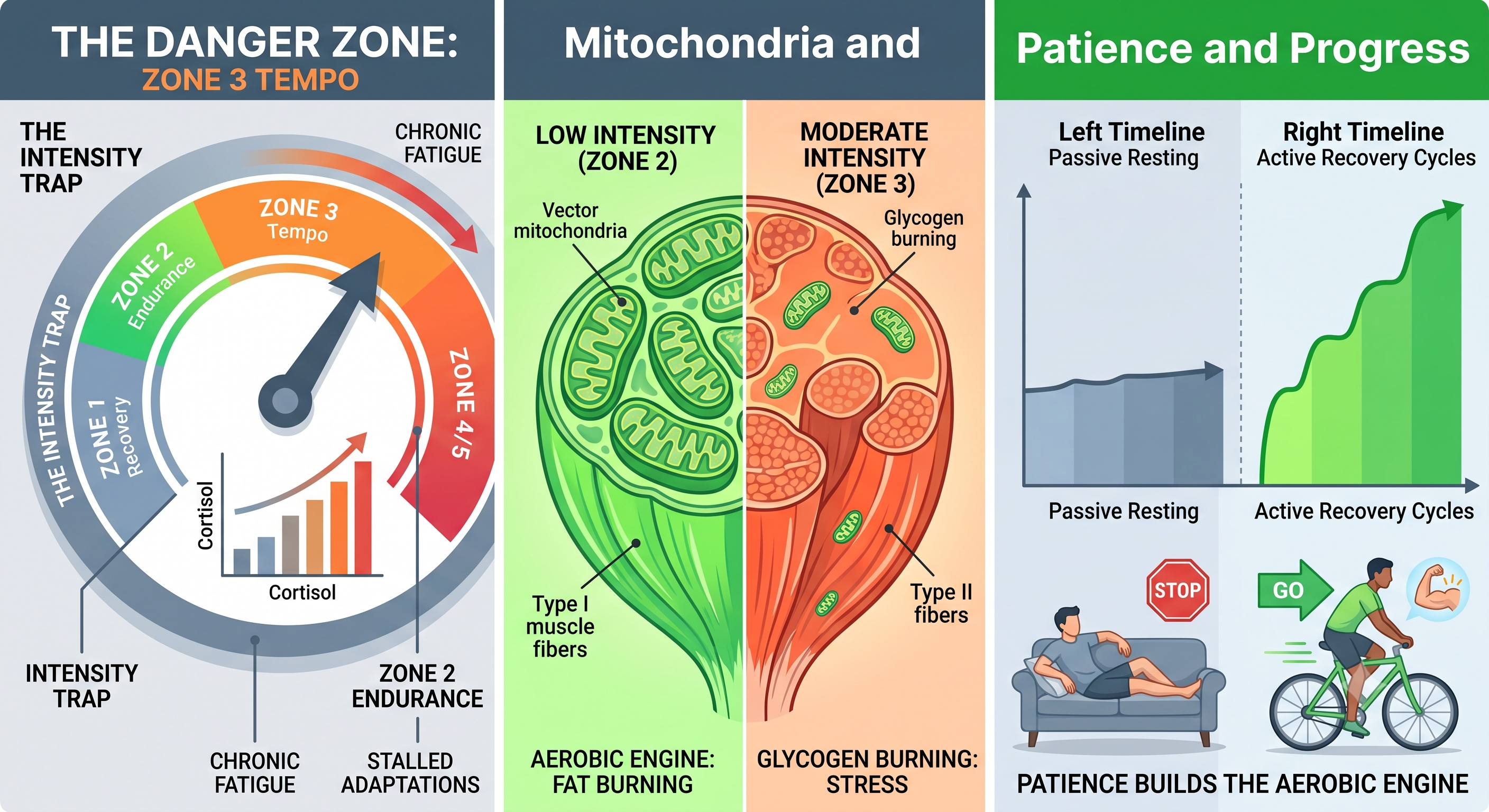
Many runners and cyclists spend too much time in the middle: hard enough to create fatigue, but not hard enough to count as a true quality session.
In a five-zone model, this often sits around Zone 3. It feels honest. Your heart rate is up, your breathing is heavy, and the workout looks respectable on Strava.
The problem is not that Zone 3 is always bad. Tempo work, steady-state riding, marathon-pace running, and race-specific efforts all have their place.
The problem is doing that intensity by accident, day after day.
When every “easy” day becomes moderately hard, two things happen:
- you accumulate fatigue faster than you can absorb it
- you arrive at your hard sessions too tired to go truly hard
That is the endurance training trap. You are working a lot, but the work is not clearly polarized. Easy days are not easy enough to restore you, and hard days are not sharp enough to move the ceiling.
Why Easy Miles Build Fast Athletes
To understand why slow training works, zoom in from the road to the muscle cell.
Easy aerobic work mainly recruits Type I slow-twitch muscle fibers. These fibers are built for endurance. They resist fatigue, rely heavily on oxygen, and contain a high concentration of mitochondria.
Mitochondria turn oxygen and fuel into ATP, the energy currency your muscles use to keep contracting. The more efficient this system becomes, the more work you can do before fatigue takes over.
Consistent low-intensity training helps stimulate several useful adaptations:
- more and better-functioning mitochondria
- improved capillary density around working muscles
- better oxygen delivery and utilization
- greater ability to clear and reuse lactate
- improved durability across long efforts
None of this feels dramatic while it is happening. That is the point.
Easy training builds the machinery quietly. Then, when it is time to race or hit intervals, that machinery lets you produce more speed with less cost.
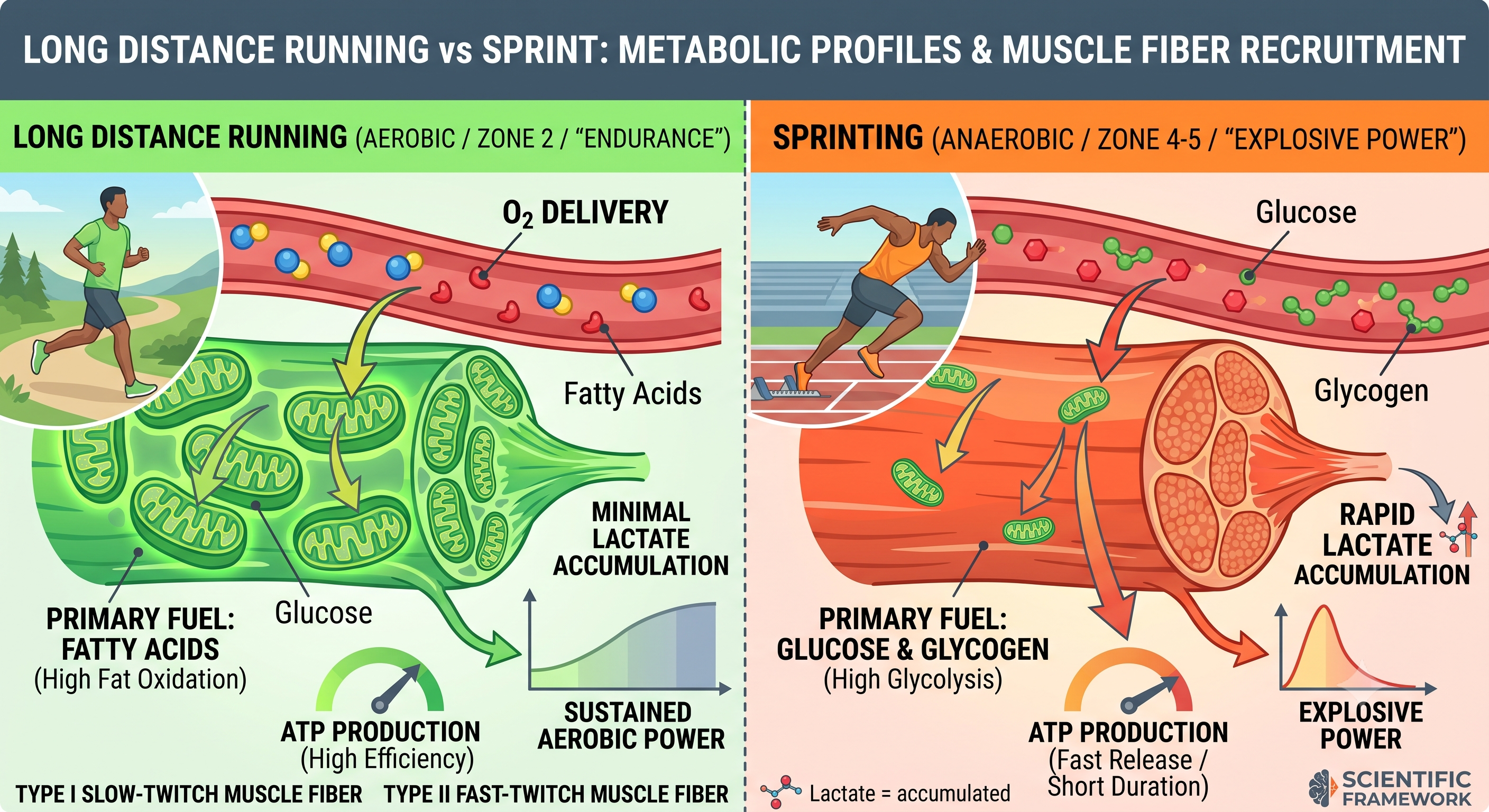
Zone 2 work relies more heavily on oxygen delivery, slow-twitch fibers, and fat oxidation, while sprint efforts lean harder on glucose, glycogen, and rapid lactate accumulation.
Metabolic Flexibility: Saving the Fast Fuel
Your body has two major endurance fuel sources.
Carbohydrate is the fast-burning fuel. It is powerful, but limited. Once glycogen stores run low, pace can fall apart quickly.
Fat is the large reserve tank. Even lean athletes store a huge amount of usable energy as fat, but the body needs a strong aerobic system to use it efficiently during exercise.
When you push intensity higher, your body relies more heavily on carbohydrate because it can produce energy quickly. That is useful during races, climbs, attacks, surges, and intervals.
But if every training session drifts upward, you spend too much time teaching the body to depend on the limited fuel tank.
Easy aerobic training helps improve metabolic flexibility: your ability to use fat efficiently at higher speeds or power outputs while preserving glycogen for moments that actually require it.
That is one reason experienced endurance athletes can look almost effortless at paces that would feel unsustainable to newer athletes. Their easy training has raised the speed they can hold aerobically.
The Maffetone Method and the Discipline of Easy
One well-known approach to aerobic base training is the Maffetone Method, popularized by Dr. Phil Maffetone.
The method asks athletes to spend a long block of training under a maximum aerobic heart rate, often estimated with the MAF 180 Formula:
Maximum aerobic heart rate = 180 - ageSome athletes then adjust that number based on recent illness, injury history, training consistency, or long-term durability.
The exact formula is not perfect for every person. No age-based heart-rate formula is. But the method teaches something many athletes badly need: restraint.
If your heart rate rises above the ceiling, you slow down. If that means walking up a hill, you walk. If that means letting the group ride disappear up the road, you let it go.
Over time, the goal is simple: move faster at the same low heart rate.
That is the sign your aerobic base is improving.
Polarized Training: Keep Easy Easy and Hard Hard
Another useful model is polarized training, often described as the 80/20 approach.
In simple terms, many successful endurance athletes spend a large share of their training volume at genuinely easy intensity and a smaller share at high intensity. The exact split varies by athlete, sport, season, and event, but the principle is powerful:
make most training easy enough to support adaptation, then make key hard sessions hard enough to matter.
This works because easy days stop stealing from hard days.
When your low-intensity sessions are truly conversational, you recover better. When you recover better, you can hit intervals, climbs, race-pace work, or strength sessions with more quality. The whole week becomes more purposeful.
That is very different from living permanently in the middle.
How to Apply This in Real Training
If you want to stop treating easy miles as garbage, start with a clearer framework.
1. Set an easy-day ceiling
Use your Zone 2 range from a recent lactate threshold test, a reliable heart-rate model, or a conservative formula such as 180 - age.
Do not treat this number as a suggestion. On easy days, treat it as a ceiling.
2. Use the talk test
If you do not have a heart-rate monitor, use your breathing.
You should be able to speak in full sentences. If you can only answer in short phrases, you are probably drifting too hard for an easy session.
3. Let pace drop without panic
At first, your easy pace may feel embarrassingly slow.
That is normal. Hills may force you to walk. Headwinds may make your cycling power look tiny. Friends may pass you. Your ego may file a formal complaint.
Let it.
Your job is not to win the easy day. Your job is to build the foundation that lets you perform when it counts.
4. Save intensity for the right sessions
Easy training does not mean never training hard.
It means making hard work intentional. Intervals, tempo blocks, race simulations, and threshold work all belong in a good program. They just work better when they are supported by enough low-intensity volume and enough recovery.
Slow Is Not Lazy
The phrase “garbage miles” gets one thing wrong: it assumes value is measured by how hard a session feels.
Endurance training does not work that way.
Some sessions build capacity. Some sharpen speed. Some restore the body. Some prepare the mind. Not every useful workout needs to leave you wrecked.
Slow miles are not a sign that you are avoiding work. Done correctly, they are disciplined work.
They build mitochondria, improve oxygen delivery, support fat metabolism, and give you enough freshness to make your hard sessions count.
So the next time your easy run or ride feels almost too easy, stay patient.
You are not collecting garbage miles. You are building the engine.