
Introducing X-Score: The Maths Behind Your 30-Day Training Momentum
A 30-minute run and a 30-minute walk are not the same effort. A long ride and a strength session are not directly comparable. And kilometres alone leave out swimmers, gym-goers, yoga practitioners and almost everyone whose sport is not measured by distance.
That is why we built X-Score.
X-Score turns your recent activity into one simple 0–100 view of training momentum. Underneath that number is a transparent, activity-independent system called X-Points. It recognizes active time, the type of activity and measurable intensity, then follows how those points move through a rolling 30-day window.
X-Score is now live on Xfitconnect. This article explains what the number means, how the calculation works and—just as importantly—what it does not claim to measure.
Three related numbers, with three different jobs
It helps to separate the vocabulary first:
- X-Points are earned by an individual eligible activity.
- 30-Day X-Points are the sum of eligible activity points from today and the previous 29 days.
- X-Score maps that rolling total onto a stable 0–100 momentum scale.
- Global rank and Top N% compare your rolling X-Points with other athletes on Xfitconnect.
Your rank does not change the calculation of your X-Score. The same 30-day X-Point total produces the same X-Score, regardless of who joins the platform, how active another club becomes or where you currently rank.
That separation is deliberate: X-Score is personal momentum; rank is social context.
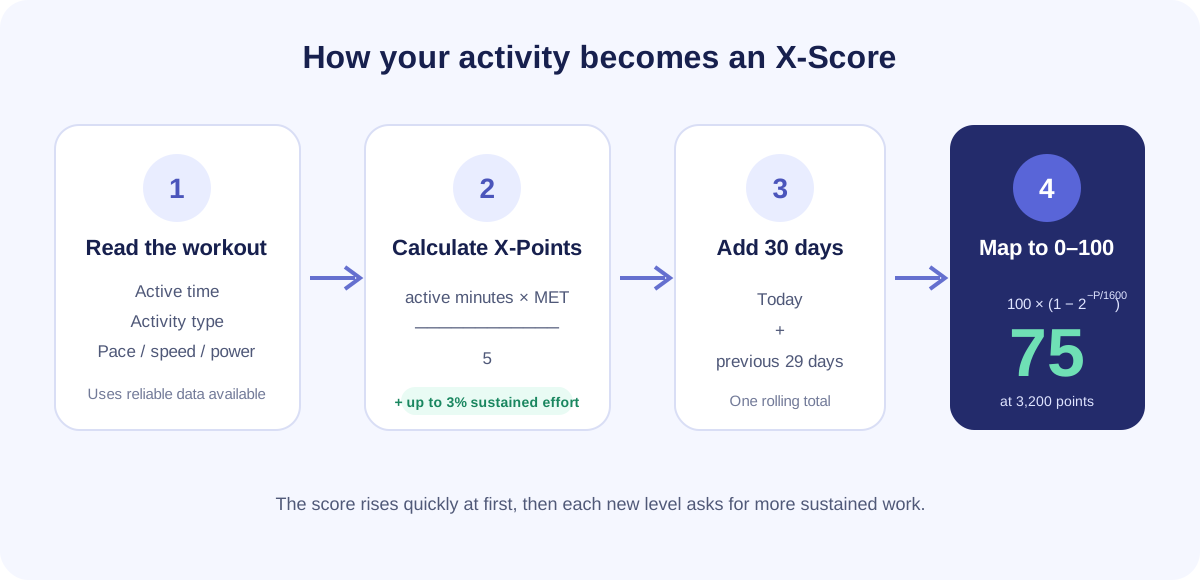
Step 1: put different activities on one common scale

The foundation is a standardized measure of activity intensity called a MET, or Metabolic Equivalent of Task. A higher MET represents an activity that typically demands more energy per minute than a lower-MET activity.
Xfitconnect uses activity mappings derived from the 2024 Adult Compendium of Physical Activities, a published reference that assigns standard MET values across a broad range of physical activities.
The base calculation is:
MET-minutes = active minutes × selected MET

base X-Points = MET-minutes ÷ 5
Or, in one line:
base X-Points = active minutes × selected MET ÷ 5Suppose a 30-minute activity is assigned an intensity of 7 MET:
30 × 7 ÷ 5 = 42 X-PointsThis common unit is what lets time spent in very different sports contribute to the same momentum system.
How the intensity is selected
Xfitconnect starts with the activity family—running, walking, cycling, swimming, strength, yoga and so on. Where reliable measurements are available, the system can choose a more specific intensity band.
For example:
- running pace can select a running intensity band;
- outdoor cycling speed can select a cycling band;
- supported indoor rides can use power;
- a recorded subtype can distinguish activities such as strength, yoga or Pilates;
- when detailed metrics are missing, a conservative family fallback is used.
The bands are intentional. Two nearly identical paces inside the same band earn the same rate, so small GPS fluctuations do not manufacture a point difference.
Missing advanced data is not a penalty. A workout can still earn points from credible activity type and active duration.
A cross-activity example
Consider these two sessions:
30-minute run at 6:00 min/km
74-minute brisk walk at 12:00 min/km
The run is assigned a higher intensity per minute, while the walk accumulates more active minutes. Before any small sustained-effort adjustment, the calculation puts both at approximately 56 X-Points.
That does not mean the experiences are identical. It means X-Points give their estimated workloads a shared language.
Step 2: recognize sustained effort without punishing breaks
For runs, rides, walks, hikes and swims with reliable moving and elapsed time, an activity may receive a small Sustained Effort boost.
The system compares active time with elapsed time:
continuity ratio = active time ÷ elapsed timeEach eligible activity family has its own calibrated range. The bonus grows gradually within that range and is capped at 2% or 3%, depending on the activity. Outdoor rides, for example, use a different policy from runs because traffic lights and technical stops are part of the real-world context.
The important rule is simple:
Breaks never remove the X-Points earned by the work you completed. Sustained effort can only add a small, bounded amount.
There is no continuity adjustment when the timing evidence is missing or unreliable. Strength, HIIT, CrossFit, yoga, Pilates and similar formats also do not use it, because planned work-rest structure should not be mistaken for poor continuity.
The bonus is applied before the final activity total is rounded:
activity X-Points = round(base X-Points × sustained-effort multiplier)Step 3: build a rolling 30-day total

X-Score uses today plus the previous 29 local calendar days. Both ends are included.
Every eligible activity contributes its full X-Points according to its local start date. A new workout enters the window; an activity naturally leaves when its date becomes more than 29 days old.
There is no daily inactivity deduction and no hidden recency weighting. Points retain their full value while the activity remains inside the window.
That creates three intuitive patterns:
- Building: new X-Points are arriving faster than older points are leaving.
- Holding steady: new activity is roughly replacing the activity leaving the window.
- Easing: fewer points are entering than leaving, which may simply reflect recovery or lighter training.
Because the visible score is rounded, your X-Points can move slightly while the displayed X-Score remains unchanged.
Step 4: turn X-Points into a 0–100 X-Score
The rolling total is converted with a fixed exponential curve:
X-Score raw value = 100 × (1 − 2 ^ (−30-day X-Points ÷ 1,600))The visible score is rounded to a whole number. A visible 100 is reserved for the explicit ceiling of 10,000 rolling X-Points; below that threshold, ordinary rounding is capped at 99.
Here are useful points on the curve:
| Rolling 30-Day X-Points | X-Score |
|---|---|
| 0 | 0 |
| 400 | 16 |
| 800 | 29 |
| 1,600 | 50 |
| 3,200 | 75 |
| 4,800 | 88 |
| 6,400 | 94 |
| 10,000 | 100 |
Why a curve instead of a straight line? A linear scale made ordinary, healthy activity patterns cluster near the bottom. The selected curve makes early and moderate momentum visible while keeping the upper end progressively demanding.
There is also a memorable way to understand the maths: every 1,600 X-Points closes half the remaining distance to 100.
- 1,600 points reaches 50.
- Another 1,600 reaches 75—halfway from 50 to 100.
- Another 1,600 reaches about 88—halfway across most of the remaining gap again.
The constants are fixed and versioned. Your score does not move merely because the wider Xfitconnect population trained more or less this week.
Why not just count kilometres, calories or workout minutes?
Each simpler option creates a different blind spot.
Kilometres favour distance sports and cannot compare a swim, strength session and run fairly. Minutes treat a gentle walk and fast run as equivalent. Calories look personal but vary substantially across devices, body-data assumptions and algorithms.
X-Points use a common, explainable workload estimate. They are designed to be consistent enough for momentum—not to pretend that consumer activity data is a laboratory measurement.
What X-Score does—and does not—mean
X-Score is a view of your recent training momentum.
It is not:
- a medical assessment;
- a diagnosis or prediction of health;
- fitness age;
- a calorie total;
- proof that more training is always better;
- a replacement for recovery, coaching or how your body feels.
A lower score is not failure. It may reflect an intentional recovery block, illness, travel, off-season training or simply a lighter month. Likewise, a high score describes accumulated workload; it does not guarantee readiness for every event.
Designed to be fair across devices and sports
The calculation prefers reliable cleaned activity evidence and resolves duplicate recordings so the same workout is not meant to earn twice simply because multiple services captured it.
The score belongs to the athlete, not to a device, club or challenge. That means your eligible activity can contribute to one canonical 30-day total across supported sources, while club and challenge comparisons remain separate.
No expensive watch is required. Better pace, distance, power and timing evidence can refine an estimate where supported, but the core system still recognizes common activity details such as type and active time.
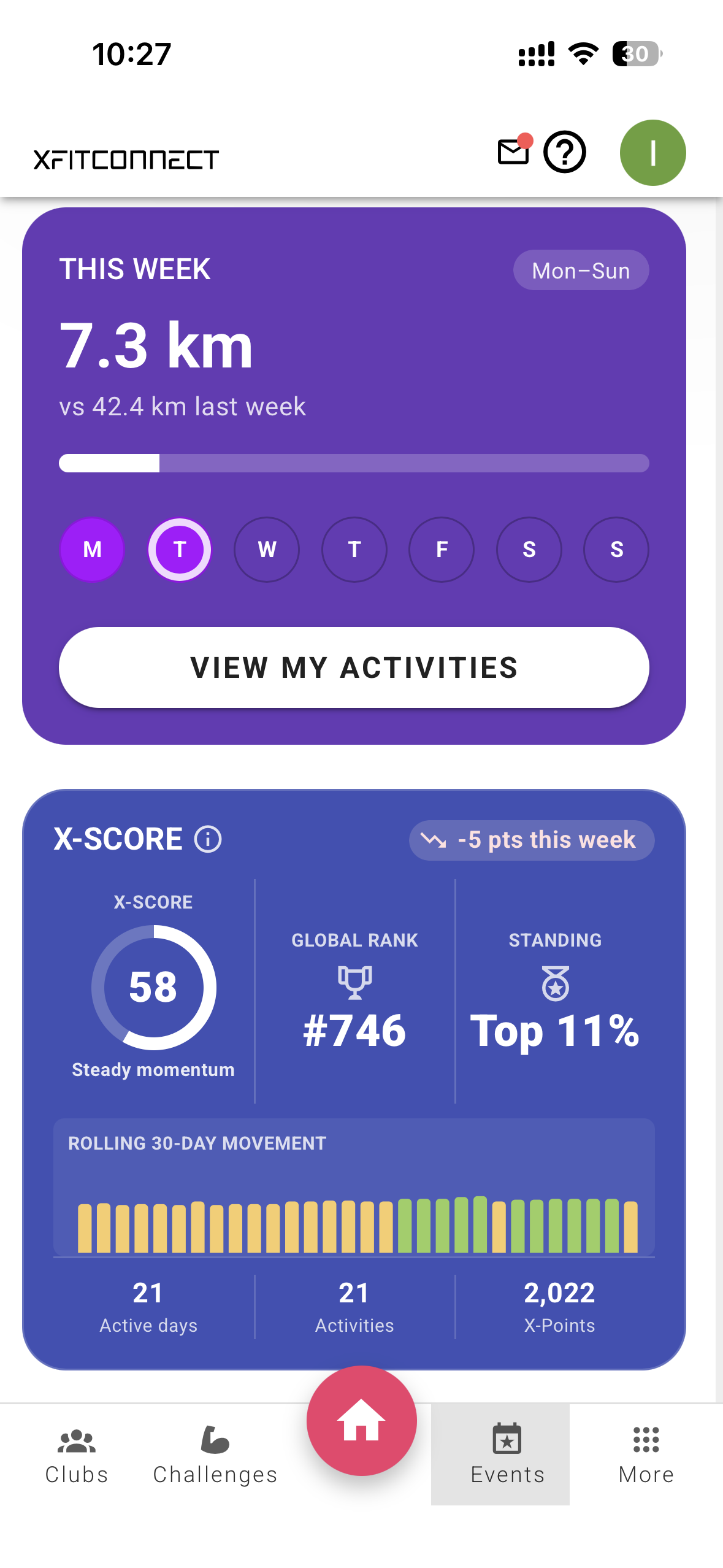
How to read the X-Score card
The live card brings the pieces together:
- the circular X-Score gauge shows the 0–100 result;
- the momentum label gives the current range context;
- Global rank and Top N% show comparison separately;
- the 30-day movement strip shows recent score history;
- active days, activities and exact rolling X-Points show what sits underneath the headline number;
- the weekly change chip can show point movement even when rounding leaves the visible score unchanged.
Tap the information icon on the card for a shorter in-app explanation and a cross-activity example.
Build momentum, do not chase a number
X-Score works best as a trend, not a daily verdict.
To build it, stay active consistently and gradually add appropriate active time or intensity within your ability. To hold it, replace roughly the amount of work leaving the 30-day window. When recovery is the right choice, let the score ease without treating that movement as punishment.
The goal is not to turn every day into a contest with 100. It is to make the shape of your recent training easier to see—across sports, across devices and across a month of real life.
Open Xfitconnect → Home or Stats → X-Score