The Science of Sustained Momentum: What 12 Months of Xfitconnect Data Teaches Us About Human Performance
New-Year training plans rarely fail due to a lack of ambition. In fact, most athletes start a season with high intention. By month two, that same energy often meets the same old wall: life, spreadsheets, and that one alarm snooze button.
This pattern is familiar across gyms, running clubs, and wellness programs:
- high initial intent, rapidly eroded by day-to-day friction,
- low execution confidence when goals feel abstract,
- little real-time feedback to confirm whether today’s effort is moving the needle.
At Xfitconnect, we tested a simple behavioral question:
Can intentional challenge design permanently close the gap between intent and action?
To test this, we analyzed 12 months of logged activity data from over 1,000 active athletes across two operational states:
- Non-Challenge Baseline: standard tracking with no active goal or leaderboard assignment.
- Challenge Active Window: structured participation in designated challenge cycles.
By measuring the same athlete pool across both states, we isolated the behavioral impact of structured competition.
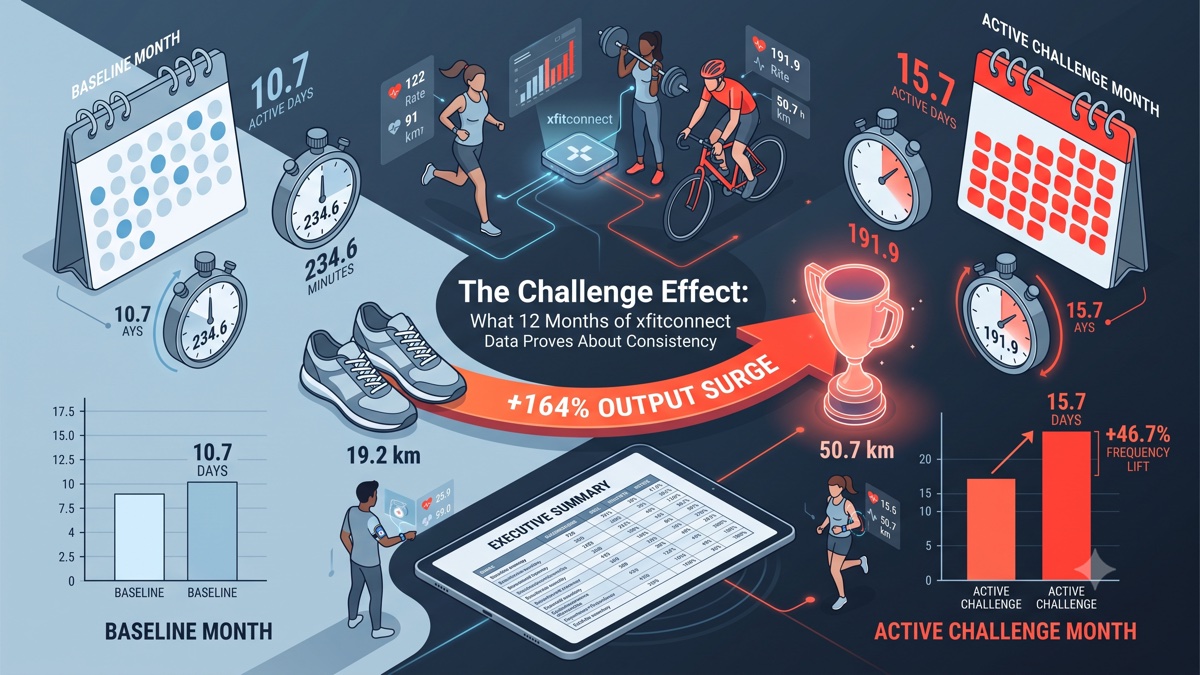
Executive Summary: The Data at a Glance
| Metric Category | Non-Challenge Baseline | Challenge Active Window | Observable Behavioral Delta |
|---|---|---|---|
| Monthly Training Volume | 10.7 days/month | 15.7 days/month | +46.7% workout frequency (+5 additional active days/month) |
| Daily Activity Output | 19.2 km/day | 50.7 km/day | +164% distance surge (2.6× physical output) |
| Training Efficiency | 234.6 mins/day | 191.9 mins/day | 2.6× output in 18% less duration (less drift) |
| Core User Participation | 232 passive loggers | 931 challenge athletes | 80% activation rate from passive to active states |
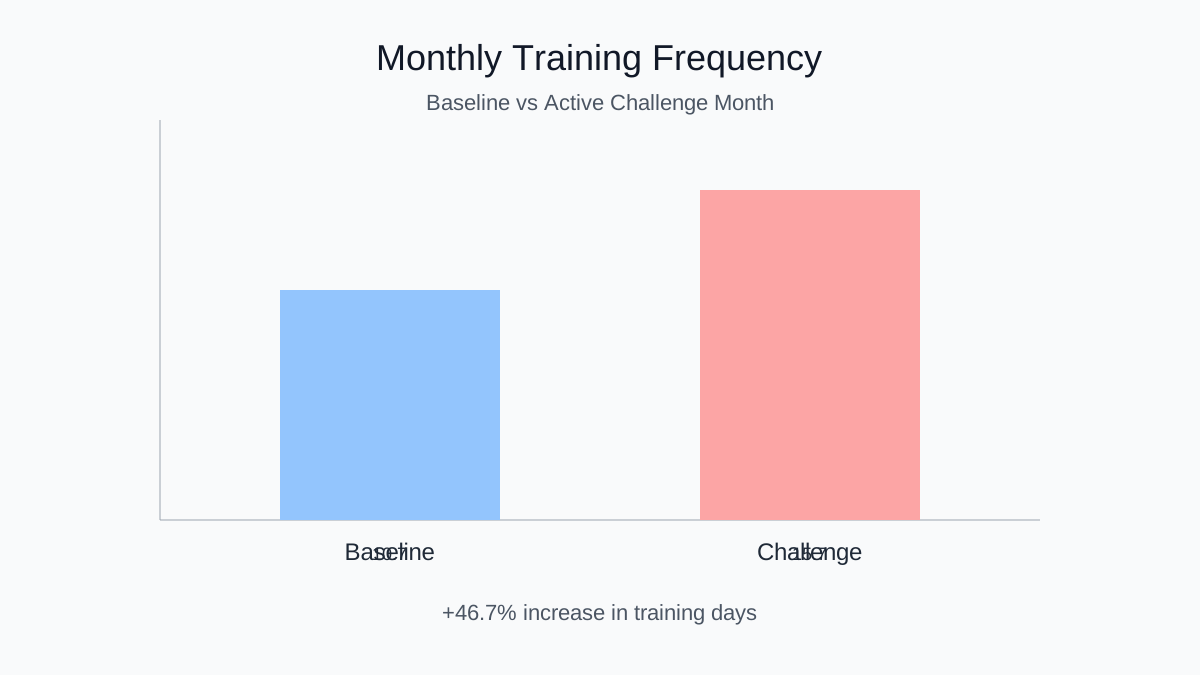
Figure 1: Baseline vs Challenge Frequency
The Headline Story Behind the Numbers
1) Frequency: Converting Sporadic Energy into Repeatable Habits
During baseline periods, athletes logged 10.7 active days/month—roughly one training day every three days. During challenge windows, the figure rose to 15.7 active days/month, nearly one every other day.
Why this matters psychologically:
In unguided environments, motivation is often reactive. Athletes decide each morning whether to train. That recurring choice creates decision fatigue. Challenge enrollment replaces that with objective expectation: a target is already set, so execution starts from intention rather than uncertainty. Five extra workout days per month compounds to about 60 additional sessions per year—roughly enough to turn “I should start Monday” into a real routine.
2) Output: Transforming Vague Intent into Measurable Volume
Daily output rose from 19.2 km/day to 50.7 km/day, a 164% increase in active days with challenge context.
The behavioral driver:
Without structure, athletes unconsciously conserve energy and stop early. When leaderboard visibility and challenge milestones are in place, the stop rule changes. Athletes extend sessions, complete planned blocks, and run additional sessions because each unit contributes to a visible outcome.
3) Time Efficiency: Higher Intensity, Less Drift
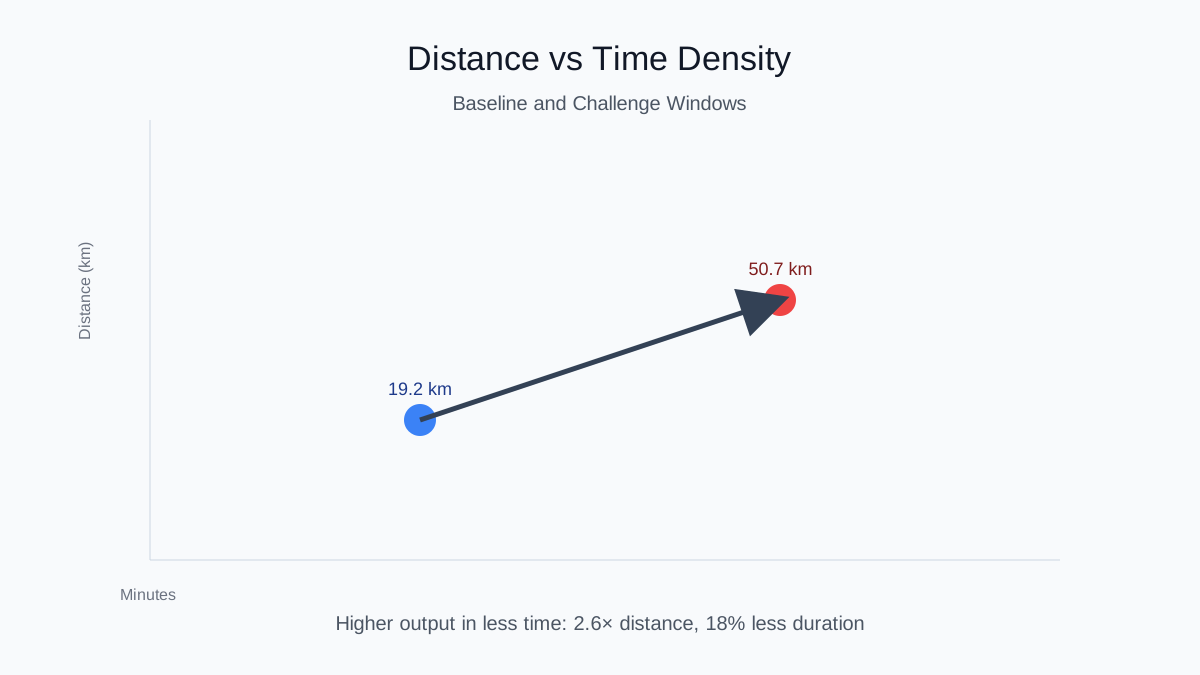
The most revealing signal is the output-time relation. Distance rose by 2.6x, but total daily moving duration dropped from 234.6 mins to 191.9 mins. In other words, participants did not merely train longer; they trained more on purpose—and less like they were “warming up” for life’s next task.
What changed:
Unstructured sessions often drift into low-value activity—longer rest intervals, aimless pacing, and inconsistent focus. Some days it can feel like the workout is doing us as much as we are doing it. Challenges create intention compression: tighter targets, clearer pacing goals, and less time wasted. The result is significantly higher output density.
4) Participation Scale: The Power of Low-Friction Activation
Participation expanded from 232 passive loggers to 931 challenge athletes in observed cohorts.
That is the difference between “I’ll look at this later” and “I just joined and can’t miss this.”
Platform lesson:
Many users do not fail from a lack of will; they fail from a lack of structure. When the pathway is simple and visible, many passive users naturally move into active challenge behavior.
Figure 2: More Distance, Less Time
Deconstructing the Engine: Why Challenge Design Works
Our analysis suggests the human brain responds to structure through three mechanics:
┌───────────────────────────────────────────────────────────────┐
│                        THE BEHAVIOR ENGINE                        │
├───────────────────────┬─────────────────────┬──────────────────┤
│ 1. Temporal Anchoring  │ 2. Ambient Visibility │ 3. Chunked Progress │
│   (Fixed Deadlines)    │    (Social Proof)     │   (Micro-Milestones)│
└───────────┬───────────┴───────────┬───────────────┴───────────┬────┘
            │                       │                           │
            ▼                       ▼                           ▼
┌───────────────────────────────────────────────────────────────┐
│              Reduced Intention-Execution Gap                   │
└───────────────────────────────────────────────────────────────┘- Temporal Anchoring: open-ended goals (“run more this year”) are easy to delay. Fixed challenge start and end dates create immediate urgency and move decisions to the present.
- Ambient Accountability: visibility to peers turns behavior into shared commitment. It is not only rivalry; it is visible, low-friction social support—the kind that nudges you before your brain files a “later” excuse.
- Chunked Progress: short milestones (7-, 14-, or 30-day blocks) create frequent completion points, reinforcing habits before motivation drops.
What This Means for Coaches, Clubs, and Team Leaders
For leaders managing performance programs, this dataset suggests a practical operating model:
- Maintain high cycle cadence: avoid long, unguided periods where momentum decays.
- Use strategic periodization: keep baseline months focused on recovery and maintenance, then use challenge windows for peak density and effort.
- Prioritize quality over raw volume: leverage efficiency gains and coach execution, not just longer durations.
A Practical 5-Point Checklist for Challenge Creators
Before launching your next community challenge, run this audit:
- [ ] Is the rulebook crystal clear? Can participants explain it in under 10 seconds?
- [ ] Is the metric easy to track? Distance, time, or active days should be obvious.
- [ ] Is the timeline short enough for focus? 14 to 30 days generally holds attention best.
- [ ] Is progress updated daily? Real-time feedback protects momentum.
- [ ] Is recognition tied to effort and consistency? Celebrate sustained behavior, not only rank.
- [ ] Does the challenge language feel human? If it needs a translator, engagement won’t.
Addressing the Skeptic: Is It Only a Short-Term Spike?
A common criticism is that challenges produce a temporary lift and then crash. Our 12-month analysis does not support that claim. Because we tracked the same users across repeated active windows, we observed sustained behavioral uplift: workout cadence remained higher, output stayed elevated, and efficiency improved over time.
Structured challenges appear to move the baseline rather than create a short-lived engagement bubble—or one of those “three-day social media hype” spikes.
Final Takeaway
Challenges do not replace personal discipline. They make discipline easier to start, easier to repeat, and easier to measure.
For athletes, challenge loops reduce daily execution uncertainty and increase both frequency and session quality. For clubs and organizations, they create an automated system for building a consistent culture.
If your goal is to lift the baseline performance of your community, challenge frameworks built into Xfitconnect offer a data-backed path to get there.